Atrium & Rooflight Glazing Repair
ARRT Group is SafeContractor accredited and can offer an insurance-backed guarantee of up to 20 years on the work.
Overhead glazing is the hardest work in the sector. There is a public concourse below, a fragile roof surface above, and no margin for a dropped object.
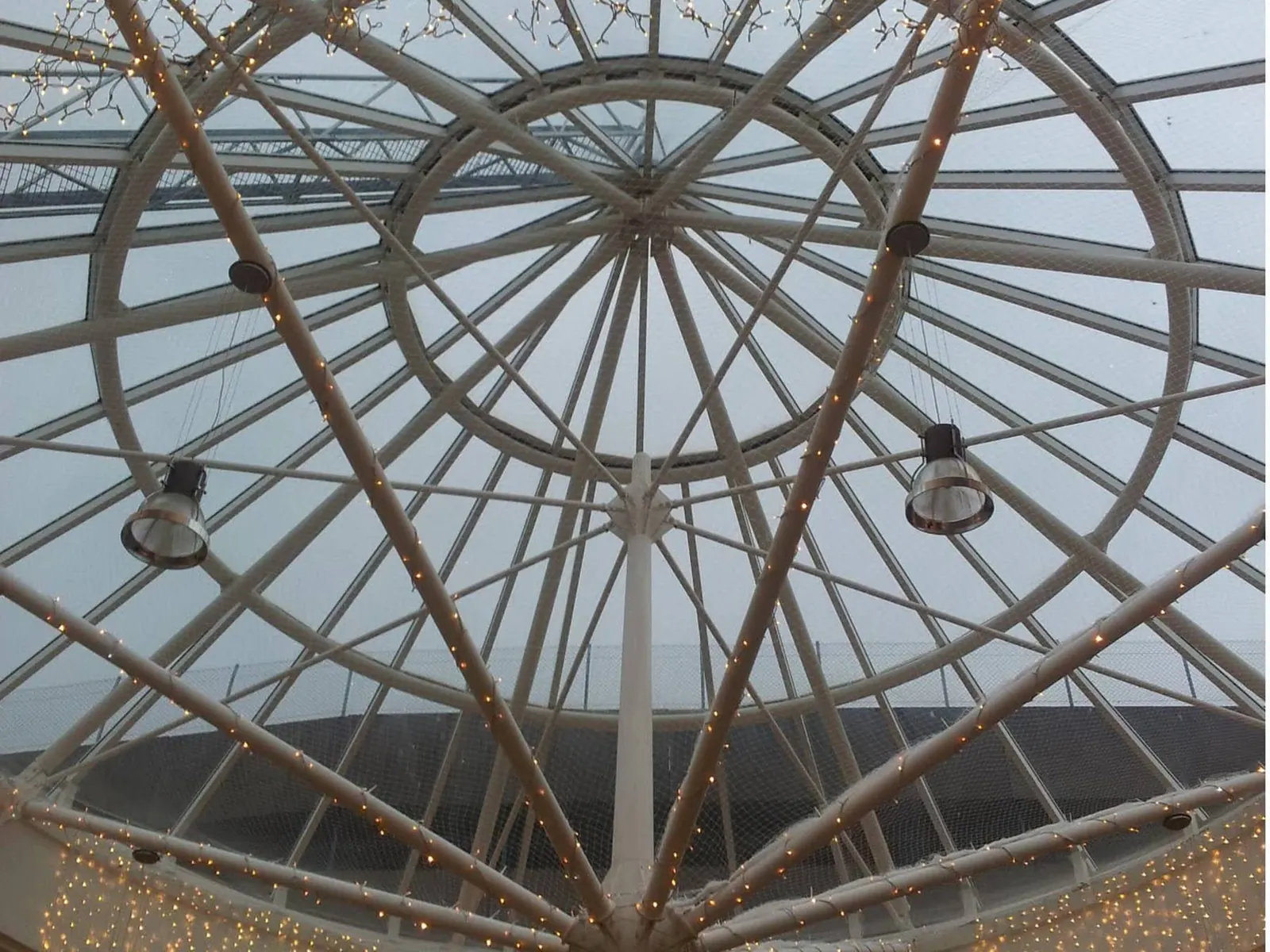
Atrium and rooflight glass repair over a live concourse in London
Overhead atrium and rooflight glazing in London needs temporary works, protection and rescue planning before unit replacement. ARRT Group plans atrium programmes for live public space across London and the South East (UK-wide for multi-site programmes), including venue experience at Alexandra Palace, a Grade II listed London landmark — single glazed Victorian heritage glass roof spider access in one working day and heritage roof-lantern rope access in two.
We plan atrium and rooflight works from the risk backwards: exclusion zones, netting, crash decks, tethered tooling, dual-rope systems, rescue provision and a sequence that keeps the space below open wherever possible. Only then do we talk about glass.
Typical scopes include replacing failed and delaminated units, renewing capping and gaskets, resealing glazing bars, resolving long-standing leaks, and upgrading fall protection and safe-access provision so future maintenance is straightforward.
Glass domes, roof lanterns and Georgian wired glass roofs over live venues
Barrel-vault roofs, glass domes and roof lanterns over occupied venues need the same risk-first planning, plus care for historic glass and framing. At Alexandra Palace, ARRT Group has carried out external sealing to the three major glazed roofs, and replaced 194 glass panes on one roof and 112 × 7mm Georgian wired glass panes on another — see the Alexandra Palace hub.
A named example of atrium spider access in London is the single glazed Victorian heritage glass roof job at Alexandra Palace: a compact tracked spider boom lift with outriggers on protected floors, reaching the glazed roof line without extensive scaffolding. Read the Alexandra Palace atrium access case study. For traditional roof lanterns and listed-building glass at height, see heritage glazing.
When the brief is a leaking glass roof or atrium rooflight leak over a live concourse, the same risk-first sequence applies: protect the space below, trace the entry path, make-safe, then a permanent seal or unit. For leak-only briefs, see glass roof leak repair. Related: glass leak repairs, high-level glass replacement and emergency glazing.
Recent examples (anonymised)
Failed high-level panel make-safe — a Heathrow-area commercial facility. A shattered curtain-wall panel at height was reported at a Heathrow-area commercial facility. ARRT attended, surveyed and cordoned the area below, then returned with a team to make the opening safe. The permanent matched unit was sourced for follow-on replacement. See emergency glass replacement and emergency glazing & make-safe.
Non-compatible toggle-bar unit at height — a London riverside office building. At a London riverside office building, a failed toggle-bar glazed unit was found to be non-compatible with the curtain-wall system. The defective unit was removed at height and replaced with a system-compatible unit so the elevation sealed correctly. Related: high-level glass replacement and rope access.
What we deliver
- Overhead sealed unit and laminated glass replacement
- Glazing bar, capping and gasket renewal
- Atrium and rooflight leak diagnosis and repair
- Delamination and failed interlayer remediation
- Fall protection, netting and safe-access upgrades
- Internal and external atrium glass cleaning
How the work is done
| Access methods | Rope access with aid climbing, scissor and boom lifts, birdcage scaffold, crash decks |
|---|---|
| Protection | Exclusion zones, debris netting, tethered tools, fully sheeted decks |
| Occupancy | Live retail, reception, station and public concourse works undertaken |
| Working hours | Predominantly out-of-hours and overnight |
| Deliverables | Overhead-specific RAMS, rescue plan, photographic close-out |
Questions we get asked
Do we need to close the atrium?
Usually not entirely. We design exclusion zones and protection so the majority of the space stays open, and reserve full closures for lifting operations, which we schedule out-of-hours.
Can you repair a leaking glass roof or atrium rooflight?
Yes. Atrium and rooflight leak diagnosis and repair are core overhead work. We trace the glazing bar, gasket or unit path, weatherproof the opening, then complete the permanent repair — see also glass leak repairs.
Can you work on a fragile rooflight?
Yes. We treat every rooflight as fragile by default — load is taken by rope systems or independent temporary works, never by the glazing.
Do you work on glass domes and roof lanterns on listed buildings?
Yes. Listed and heritage glass roofs — domes, roof lanterns and Georgian wired glass — are reached by rope access or compact spider access so the venue below stays open. See heritage glazing and the Alexandra Palace hub for named Grade II work.
Often needed alongside this
High-Level Glass Replacement
Failed, cracked, blown or vandalised units replaced at height — from single panes to full elevations, with access designed around your building.
View service 02Curtain Wall Refurbishment
Extend the life of an ageing aluminium facade — gaskets, seals, drainage, fixings and finishes brought back to a serviceable, watertight standard.
View service 04Leak Detection & Repair
Find the actual entry point instead of resealing everything and hoping — forensic water testing, tracing and a targeted, evidenced repair.
View service
Need a specialist on site?
Send us the building, the defect and a photograph if you have one. We will tell you the access method, the likely scope and a realistic programme.