
Commercial Glass Replacement Without Scaffolding
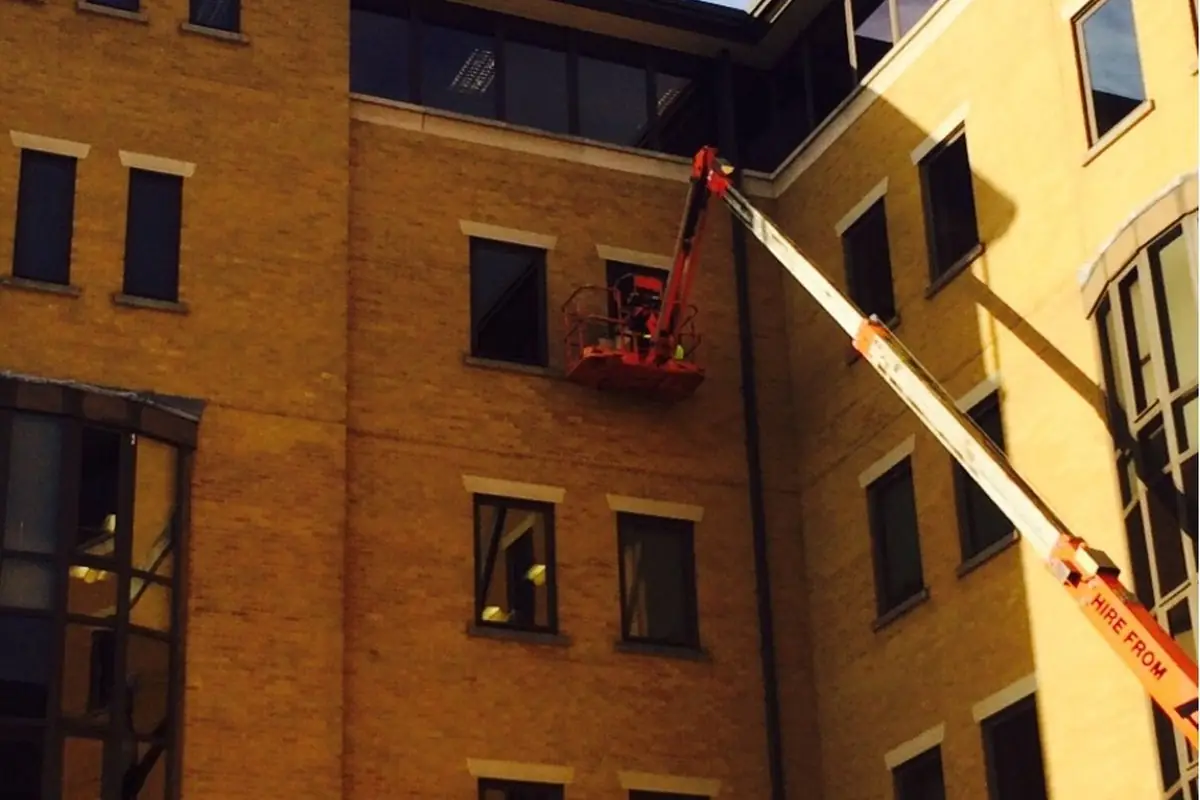
For one failed unit at height, scaffold can cost more than the glass. We use rope access, MEWP or spider lifts instead.
ARRT Group is SafeContractor accredited and can offer an insurance-backed guarantee of up to 20 years on the work.
Commercial glass replacement without scaffolding
ARRT Group replaces commercial glass at height without scaffold wherever the job allows, using rope access, MEWPs, tracked spider lifts and internal access instead. For one-off failed units, cracked panes, atria and glass roofs, that usually means less disruption, a shorter hire period and entrances that stay open. We work from our London HQ and our Midlands office in Radcliffe, Nottingham, with UK-wide programmes. Call 020 3780 3001.
Why avoid scaffolding for glass replacement?
Scaffold has its place, but for a single failed unit it can mean design work, licences, hoarding, weeks of hire and a blocked entrance, often before any glazing starts. Scaffold-free access can mean:
- Faster mobilisation, because there is no structure to design, erect and strike
- Lower access costs on one-off or scattered repairs
- Entrances, pavements, car parks and shopfronts kept open
- No scaffold standing against an occupied building as a security risk
- Less impact on tenants, guests and how the building looks
Whether these benefits apply depends on the building, which is why we survey first and compare methods honestly.
Access options we use instead of scaffold
- Rope access. For elevations, atria, domes and sloped glass roofs, with a minimal footprint. See rope access glazing.
- MEWP or boom lift. Cherry pickers for elevations and canopies where there is firm, clear ground to set up on.
- Tracked spider lift. Compact platforms that fit through doorways and work on protected floors inside atria and concourses.
- Internal access. Towers and podiums for internally glazed systems, with floor protection.
- Lifting equipment. Vacuum lifters and, where the unit weight needs it, a crane.

When scaffolding is still the right answer
We are honest about this. Large replacement programmes over many floors, very heavy units that cannot be lifted any other way, or work combined with other trades may justify a scaffold. If so, we will say so and explain why, and we can often still reduce how much is needed.
Example: spider access inside a live heritage atrium
At Alexandra Palace, a Grade II listed London landmark, a compact tracked spider boom lift was set up on protected floors to reach a single glazed Victorian heritage glass roof in one working day, without extensive scaffolding, while the venue stayed open. Read the Alexandra Palace atrium access case study.
How a scaffold-free replacement runs
- Survey. We identify the glass and the system, measure the unit, work out its weight and choose the access method.
- Make-safe. If the glass is cracked or broken, we fit a temporary cover or boarding and cordon off the area below. See emergency glazing.
- Order. We order matched units. Lead time depends on the glass type and size, and we confirm it with the order.
- Replace. We remove the failed unit, prepare the rebate, then install the new unit with new gaskets or sealant.
- Record. Before-and-after photographs and the unit specification for your records.
What helps us quote quickly
Send photos of the failed glass and of the elevation, the approximate height, what sits below it (an entrance, car park, pavement or roof), any marks etched in the corner of the unit, and any access restrictions or trading hours. With that, we can often suggest the likely access method before we survey, and the survey then confirms the unit size, the glass type and the programme.
Which page fits your job?
This page explains how we avoid scaffold. For a broader view of planned replacement at height, see high-level glass replacement. For dangerous or broken glass that cannot wait, see emergency glass replacement. If the glass is in a roof and leaking, see glass roof leak repair.
What we deliver
- Method comparison at survey: rope access, MEWP, spider lift, internal access, scaffold
- High-level sealed unit and pane replacement without scaffold
- Atrium and glass roof glazing from spider lifts and ropes
- Temporary make-safe and cordons for broken glass
- Vacuum lifting and crane coordination for heavy units
- Photographic record and unit specification at handover
How the work is done
| Access methods | Rope access, MEWP and boom lift, tracked spider lift, internal towers and podiums |
|---|---|
| Best suited to | One-off and scattered units, atria, glass roofs, occupied entrances |
| Scaffold used when | Large multi-floor programmes, units that cannot be lifted otherwise, multi-trade work |
| Sequence | Survey, make-safe, order, replace, record |
| Working hours | Daytime, out-of-hours and agreed service windows |
| Coverage | London HQ, Midlands office in Radcliffe, Nottingham, UK-wide programmes |
Questions we get asked
Can high-level glass be replaced without scaffolding?
Usually, yes. Most single units, scattered repairs, atria and glass roofs can be reached by rope access, MEWP or a tracked spider lift. We confirm the method at survey.
Which is better for glass replacement, rope access or a cherry picker?
It depends on the ground, the height, the weight of the unit and what is below. MEWPs suit elevations with firm, clear ground. Rope access suits elevations and roofs where a machine cannot set up. Spider lifts suit internal atria.
How heavy a glass unit can you replace without scaffold?
There is no single figure. It depends on the access method and the lifting equipment. We calculate the unit weight at survey and choose suction lifters, a MEWP, a spider lift or a crane to suit.
Is glass replacement without scaffolding cheaper?
For one-off and scattered replacements it often is, because there is no scaffold to design, hire and strike. For large multi-floor programmes, scaffold can sometimes be better value. Where it is close, we price both.
Can the building stay open while you replace the glass?
Yes. We cordon off the work area, protect the floors and phase the work around trading, so entrances and floors stay in use wherever possible.
Often needed alongside this
High-Level Glass Replacement
Failed, cracked, blown or vandalised units replaced at height, from single panes to full elevations.
View service 02Rope Access Glazing
Glass replacement, sealing and make-safe on ropes with a minimal footprint.
View service 03Emergency Glass Replacement
Make-safe first, then the permanent unit, for broken glass that cannot wait.
View service
Failed glass at height?
Call 020 3780 3001 or use the short form. We will tell you the access method, the likely scope and a realistic programme, and whether scaffold is really needed.